Clean solar electricity, around the clock
At any given moment, it is daylight somewhere on Earth and night elsewhere (video). Intercontinental HVDC links can move power from where it is being generated to where it is currently dark.
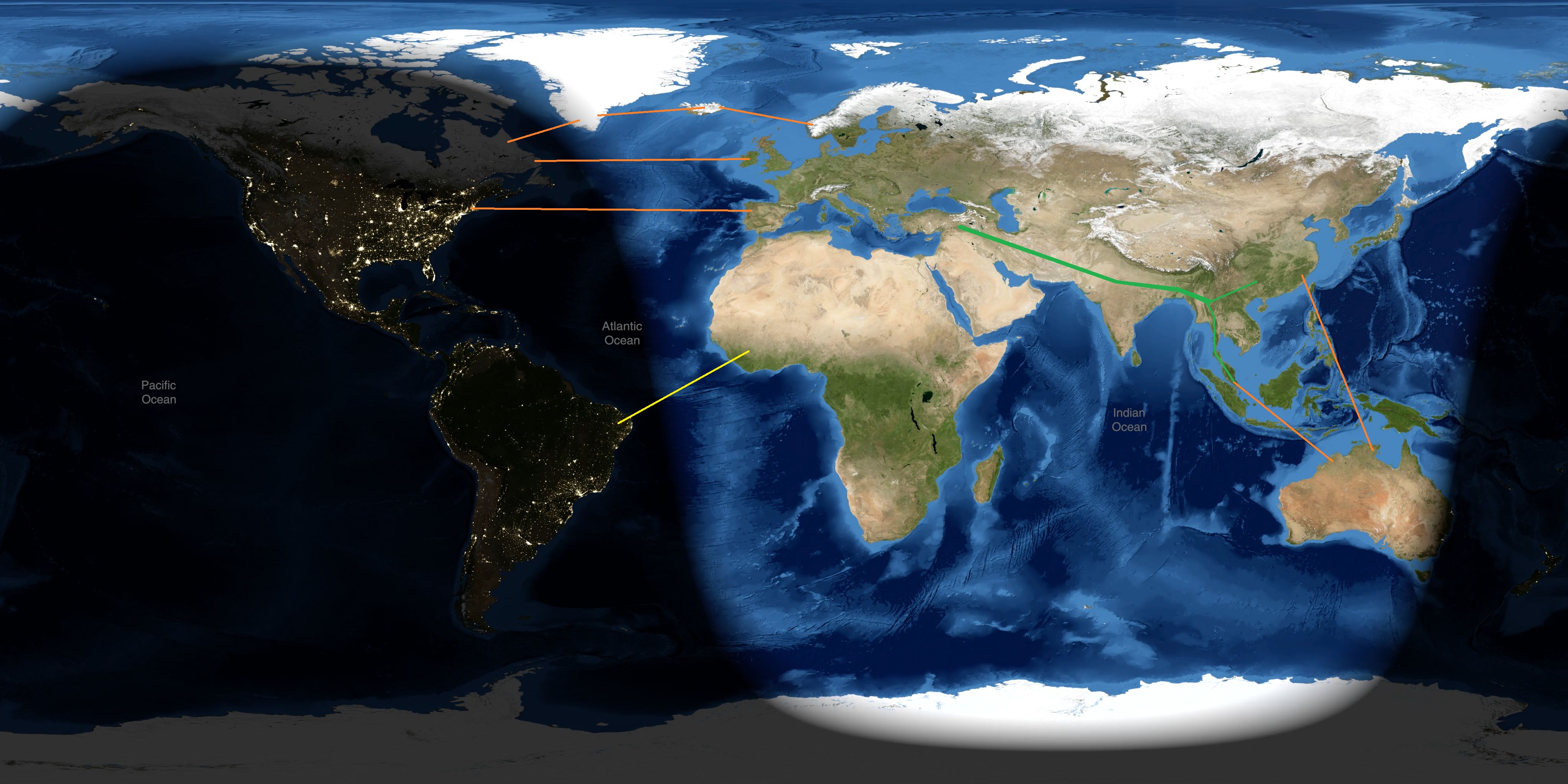
Link legend: orange – intercontinental key HVDC links, green – backbone links forming the global spine, yellow – additional connecting links.
Why this must be solved system-wide
The sun is always shining somewhere
Because Earth rotates, solar generation is always active somewhere. Night in Europe does not mean night for the whole planet.
How much solar PV is actually needed
Using empirical land-use energy-density data for utility-scale PV from 2011–2019 (LBNL), covering today’s global electricity demand (~29,471 TWh/year in 2023) would require on the order of 270–300 thousand km² of solar parks—about 0.2% of the world’s land area.
The real constraint isn’t land
The constraint isn’t solar resource or land, but moving energy between regions and aligning generation with demand in time.
How it works
Generation is geographically distributed
Solar generation spread across continents produces at different times. Because Earth rotates, there is always daylight generation somewhere.
Transmission aligns time mismatches
High-voltage direct current (HVDC) enables efficient long-distance transfer with low losses and can connect asynchronous grids. Power can be moved from generating regions to consuming regions.
The system reduces energy storage requirements
Some short-term and seasonal storage needs can be replaced by transfer between regions. Storage remains important, but it is not the only—or dominant—stability tool.
Key global links
North Atlantic: USA/Canada – Europe
A prime early link is the North Atlantic corridor. An HVDC route from the USA or Canada to Norway or the UK would connect two strong, time-shifted regions.
Europe already operates a large interconnected network reaching to Turkey. The USA and Canada also have extensive interconnected systems. This link would create the first true transatlant
Australia – Southeast Asia
Another key direction is Australia–Asia. An HVDC link between Northern Australia and Singapore is already in concrete project and permitting stages.
This direction is critical for moving solar energy from high-irradiance regions into densely populated parts of Southeast Asia.
Eurasian backbone: Europe – Middle East – Asia
To become truly global, Europe must connect further east. Via Turkey, overland or HVDC links can extend toward the Middle East and onward to South and Southeast Asia.
This would form an energy spine across Eurasia, enabling inter-regional sharing and significantly improving the stability of a renewables-based system.
Real projects
Sun Cable (Australia – Singapore)
An HVDC project linking Northern Australia to Singapore, based on large-scale solar PV and 4300km long-distance transmission.
Xlinks (Morocco – UK)
A project to transmit renewable electricity from Morocco to the UK via subsea HVDC cables—one of the longest planned HVDC systems in the world.
NATO-L (USA/Canada-EU)
NATO-L will connect North America to Western Europe via Eastern Canada and UK & Ireland through a 6GW HVDC set of subsea cables. The length of the cables is 4,000 kms.
Contact
Contact: www.elekele.cz